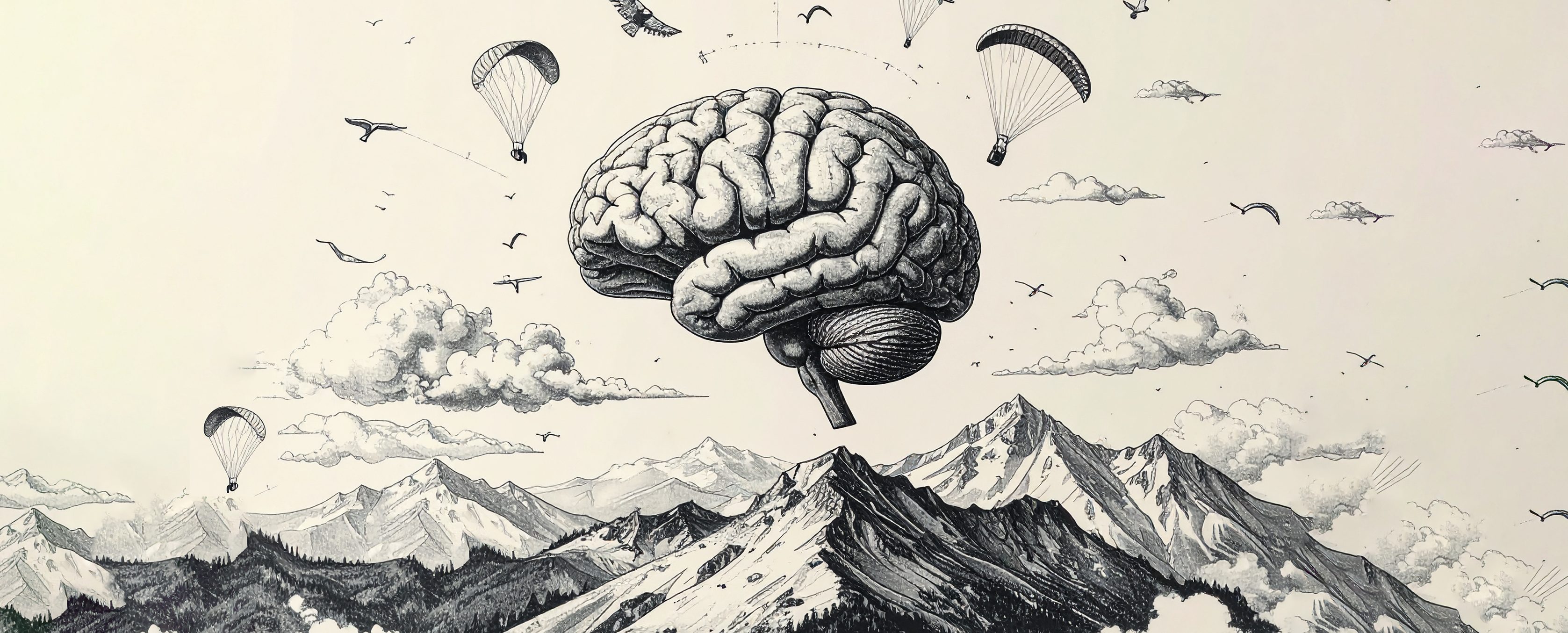
Biology in paragliding
How it works in the brain
Learning something new – or unlearning the wrong way: When you learn to paraglide, you dive into a world full of new impressions, movements, and sensations.
At our paragliding school, we see every day how pilots absorb new skills, correct old patterns, and gradually become safer in the air. But how does learning actually work? Why can we internalize some things quickly, while others stubbornly stick the wrong way? The answer lies in our brain. Learning is not magic, but biology – and that’s exactly what makes it so fascinating.
The biology of learning
Two neurotransmitters are crucial when we want to learn something new in paragliding or unlearn bad habits. When these two are present, learning must take place:
- Acetylcholine – It ensures that we are attentive and can distinguish important from unimportant information. The brain marks: ‘This is relevant!’
- Noradrenaline – It occurs when something is new, unexpected, or emotionally charged. It makes us alert and ready to store information.
Without these substances, experiences often remain fleeting. With them, we anchor new skills – whether it’s launching, steering, or landing a paraglider. Both states, being focused and emotionally charged, occur in abundance while flying and make our sport so appealing. That’s why learning happens anew with every launch and every flight, and why we remember the moments we experience.
The role of intention
But biology alone is not enough. To truly make progress in flying, a clear intention is needed. Those who practice without focus leave it up to the brain to decide what sticks – and often it’s not the right thing.
Those who consciously set the intention: ‘Today I’m practicing the launch in crosswind’ or ‘I’m training my orientation in motion,’ give the brain a strong signal. It knows what to focus on – and anchors exactly that.
Example: Orientation in motion
One of the most important skills in paragliding is orientation during flight – especially in turbulent situations.
- Before the movement: The brain registers the starting point and the intention.
- During the movement: We actively locate ourselves in space, comparing the actual course with the intended course.
- Afterwards: We mentally simulate where we will be next – and make decisions for safety and efficiency.
Those who clearly state during training: ‘I am now practicing orientation in motion,’ combine biology and intention. This creates stable patterns that can be recalled in critical situations.
Here: a short article on the importance of orientation in flight
Conclusion: Learning in paragliding
Learning something new or unlearning the wrong way starts in the mind – and works best with clear intention and knowledge of the biological foundations. At our paragliding school in Zurich and Lucerne, we focus exactly on this: structured training, conscious exercises, and the right mental attitude.
Because in paragliding, it’s not just about mastering the glider, but about deliberately programming the brain: This is important – this is what you want to be able to do.