Orientation in Paragliding
The most important skill and also the underrated lifesaver
Flying means freedom and intense experiences of moving through space. Whether in paragliding, daily commuting, or life in general, the ability to orient oneself while moving through space is essential.
Precisely because it is so fundamental and commonly used everyday, that this ability is not recognized for what it truly is: a skill that can be deliberately trained.
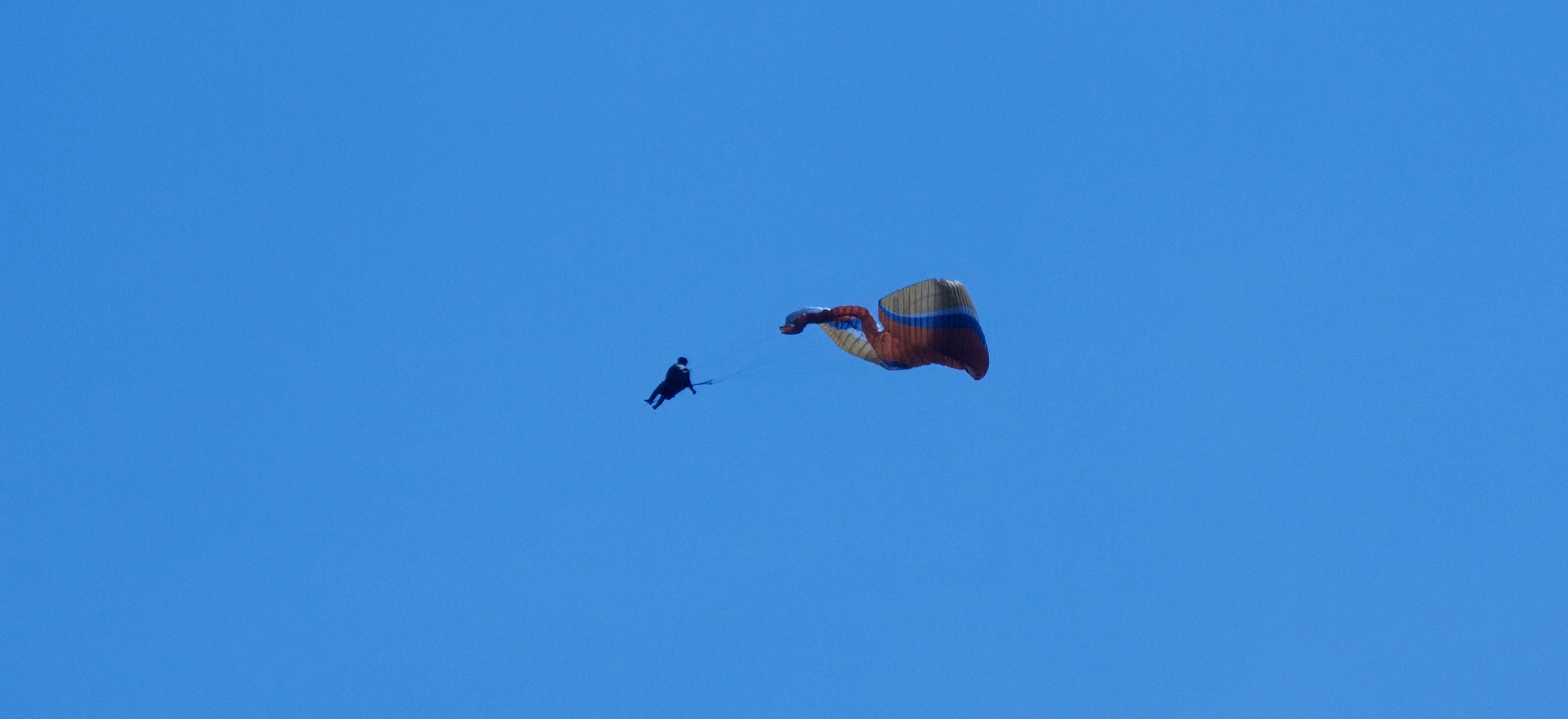
Many critical situations do not arise from equipment failure or bad weather, but because pilots fail to orient themselves properly in space. And it starts already on the ground – for example, when laying out the wing unfavorably at the launch site or when the glider unintentionally turns toward an obstacle.
The most difficult skill in safety training
In safety training, participants learn how to respond to collapses, stalls, or spirals. But the real challenge is often not the maneuver itself – it’s maintaining orientation during and after. Eight out of ten pilots, even experienced ones, struggle to quickly assess their spatial position and reposition themselves effectively in the maneuver box after a rapid glider movement.
A defining experience
In the spring of 2001 in Interlaken, during my first independent flights, I flew in the same glider as the test pilots from Advance. While many pilots were still struggling with the rough spring air, one of them used the rolling and pitching motion after a provoked collapse to fly back to the center of the thermal in a single, fluid turn. A prime example of practiced orientation – and an image that still resonates decades later and has always served as a model for me.
Why orientation is so crucial in paragliding
Orientation means more than just knowing where you are. It is the ability to consciously perceive your body, the glider, and the terrain in motion. Without this ability, poor decisions often follow: leaving the slope too late, incorrect control inputs, or even freezing in a moment of panic. Even a brief tunnel vision can turn a tricky situation into an accident.
Stress makes you blind
Under stress, our brain reacts automatically: our vision narrows, and creative solutions are blocked. Inexperienced pilots then fall back on untrained patterns – and sometimes unconsciously steer straight toward danger.
Training orientation – the three principles
The good news: orientation in paragliding can be trained. Three simple principles help you make the right decision when it really counts:
- Always head toward open terrain – get out of the danger zone.
- Always into the wind – to reduce your speed relative to the ground.
- Always away from the mountain – distance means safety.
To consciously practice orientation, all maneuvers are suitable, such as wingovers, tight turns, or collapses. The key is the focus: it’s not the maneuver itself that is central, but the ability to orient yourself in space according to the principles above.
Conclusion
Orientation is a cornerstone of safe flying. It not only protects you, but also makes flying purposeful and brings control to your movement. Those who train this skill remain capable of action even in stressful moments. Because in the air – and in life – the rule is: we must always know where we are and where we are heading, or else we will be controlled.
On paraworld.ch you can find advanced training camps and safety courses for the next season. Ideal for sharpening your orientation skills and taking your flying technique to the next level.