Understanding and Training for Even Better Flights
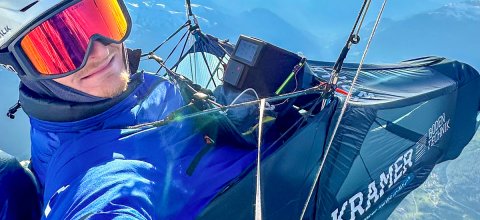
The goal of the paraworld.ch paragliding school is clear: every pilot should fly as comfortably, relaxed, and efficiently as possible. A relaxed body posture creates mental capacity. Mental capacity leads to better decisions — and good decisions increase safety.
In practice, however, we often observe the following in the flight school, on flying trips, or during safety trainings:
Paraglider pilots are not sitting optimally in their harness
Movement patterns are unconscious or not functional
In stressful situations, movements often occur that reduce safety rather than improve it.
With this article, we aim to improve understanding of one’s own body posture and explain functional movement patterns ultimately increasing both flying enjoyment and safety.
Basics: The Correct Harness Setup
Adjusting a paragliding harness may seem simple, but it is surprisingly complex. Competition pilots often invest hours in achieving the perfect setup because they know: comfortable and relaxed flying is essential for both performance and safety.
A well-adjusted harness enables:
Fatigue-free flying
Brake inputs that run parallel to the risers
Good support across the entire backreichs
A compact and relaxed body posture
Harness setup alone could fill an entire article. That’s why our tip is simple: feel free to drop by our shop with no obligation we’ll take a look at your settings together and help you optimise them.
Functional Movement Patterns and Body Posture
When observing professional athletes, one thing immediately stands out: they have full control over their movements, and their movement patterns appear fluid and functional.
They always know where their individual body parts are
Even under stress, their movements remain conscious and coordinated
They act deliberately, not reflexively
The better we perceive our body, the better we understand what we are doing. And only when we know what we are doing can we actually do what we want.
Without this awareness, “something just happens.” And since we move in an element that is not natural to us when paragliding, that is often exactly the wrong thing.
Here are a few typical unconscious movements and reactions of paraglider pilots:
The gaze goes toward the danger instead of toward safety
Sitting upright and tensing the torso in turbulence
In turns, the outside arm moves far outward
Uncontrolled tension instead of deliberate movement
Mental blockage instead of an adapted response
The list could go on.
Safety: When Wrong Patterns Become Dangerous
Movement patterns that make sense on the ground can be fatal in the air. Typical examples in different situations:
In turbulence: Tensing the torso and sitting more upright — the harness becomes more unstable, which in turn increases tension even further. The signal sent to the brain is: danger! Free and creative thinking disappears.
During wing disturbances: The pilot tilts sideways or backwards in the harness — the arms reflexively move outward or backward.
Wide arm position while flying: Anatomically, this is not a sensible position for the shoulder joint. You have less control, tire more quickly, and in the event of a collapse you tend to make even larger corrective movements instead of letting the wing fly itself.
Startle reactions (e.g. in a spiral): The body goes into protective tension and blocks. Both clear thinking and appropriate reactions disappear. In stable spirals or with line twists, this can be fatal.
The Solution: Developing Understanding Through Simple Exercises
To truly understand all of this, we first need to become aware of our normal movement patterns. Our movements only become truly effective when they are conscious and adapted to the situation. Paragliding is a combination of weight shift and brake input, so the entire body should move in a functional way.
Exercise 1: Pulling and Rotating
Sit down and grab a handle at about head height for example, the grab handle in a car. Similar to sitting in a harness and pulling the brake. Pull on it and observe what happens with:
The lateral core muscles
The pressure of the hips on the seat
Upper body rotation
Exercise 2: Direction of Gaze
While sitting or standing, first move your eyes, then slowly turn your head:
to the right
to the right and slightly upward
to the right and downward
Pay attention to the smallest movements in your hips, back, chest, and shoulders.
Exercise 3: Combination
Hold the “brake handle” and play with variations. Pull on it while consciously changing your direction of gaze. Or change your gaze first and then pull.
Do you notice a difference?
Exercise 4: Chest vs. Shoulder
Sit comfortably in your harness or at home on the sofa and during the following movements ask yourself which muscle groups you are using.
While seated, move your left side of the chest slightly forward.
Press your right shoulder into the harness.
Combine both: does it become easier?
Combine the direction of gaze and pulling on the handle with this exercise
Exercise 5:Find the 1000-franc note in the lee
Imagine a 1000-franc note between your shoulder blades. Can you feel it?
Now think of an uncomfortable lee rotor and turbulence:
Is the note still there?
Has it changed position?
Ideally, the note always stays in the same place. The contact between your spine and the harness remains calmly and consistently relaxed.
Developing Basic Body Awareness - On the Ground and in the Air
Our body awareness can be trained, and with the right practice you will perceive your movements more and more clearly. This can be done both in flight and at home on the sofa.
Consciously noticing body sensations:
Pressure of the shoulders in the harness
Tension or relaxation in the torso
Sensation in the hands
Pressure in the harness where is it strongest, where is it lighter?
Seeing:
Where are my hands?
Where are my elbows?
Observing:
Watch other pilots and recognise your own mistakes in their movements
Intentionally making mistakes
Fly with your arms as wide as possible
Deliberately tense your torso
Sit more upright in your harness
Steer only with the brake while looking in the opposite direction
Consciously making mistakes creates understanding and control. Try this within a safe setting during a relaxed glide. Anyone who knows how mistakes feel will recognise them earlier and can correct them.
Conclusion
Relaxed sitting, functional movements, and good body awareness are not a given. They are trainable foundations for safe and enjoyable paragliding and a surprisingly complex topic.
Feel free to stop by our paragliding shop. We’ll be happy to help you personally and support you.