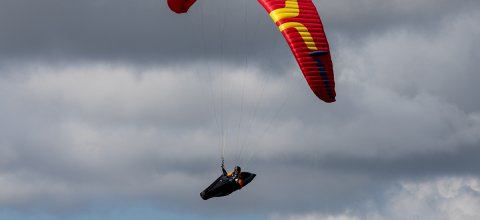
A detailed experience report on the Ozone Delta 5: direct handling and high comfort with two-liner performance!
A flying week in southern France provided the ideal stage to thoroughly test the Delta 5 in a wide range of conditions—from wind-torn 6-meter tubes at Cheval Blanc to calm evening soaring above the Verdon Gorge at sunset. Everything was covered.
Unboxing
A first look at the wing reveals a lot of new features: the Delta 5 is now a true two-liner. The new risers are particularly impressive, with height-adjustable B-handles and a clever brake-line attachment that combines a magnet and a snap button. The line layout is clean and simple: three A lines, three B lines, and the brakes.
Despite all these new details, as a long-time pilot of the previous versions I immediately feel at home—the moderate aspect ratio and excellent build quality remain unchanged.
Groundhandling and Takeoff
The launch site for the first flight could hardly be more beautiful: rolling hills, rugged cliffs, the Lac de Serre-Ponçon, and the village of Saint-Vincent in view. I lay out the Delta 5 on the perfect artificial grass and immediately appreciate the tidy, easy-to-sort risers.
At launch, a firm, decisive impulse helps the wing inflate quickly and spread out fully. It then rises calmly and reliably as a single, cohesive unit. The horseshoe or banana shapes known from the predecessor are gone, and corrections are hardly necessary. The Delta 5 shows no tendency to overshoot or make abrupt movements, and it doesn’t stall immediately even with too much brake input. Whether in strong wind, standing in lift, or during the acceleration run, the wing remains dependable overhead and gently lifts me into the air after just a few steps.
During further ground handling, the new reflex profile quickly becomes noticeable: if the wing overshoots, it slows and stabilizes itself instead of immediately collapsing. Of course, you shouldn’t rely on this during launch, but it’s a clear indication of what to expect in the air—a wing that actively supports the pilot.
And important for anyone familiar with the predecessor or its “younger siblings,” the Rush 6 or Swift 6: with a forward launch, the Delta 5 once again rises reliably, straight, and as a solid wing—no tricks or silent prayers required.
Thermals and XC - Flying
This is exactly what the Delta 5 was built for—and it delivers on its promise!
One of my test flights takes place in the southern French XC mecca of Saint-André-les-Alpes. In late September, conditions are ideal: a high cloud base, strong climb rates, and moderate wind.
Hardly airborne, I notice—like the other pilots—that a group of griffon vultures is circling a few hundred meters out on the plain. So I head straight for them at full speed, not wanting to miss out. Even on the first speed-bar stage, I gain over 10 km/h of extra speed; on full bar, the airspeed indicator still shows more than 50 km/h despite a headwind. Later it becomes clear: in size ML, the wing accelerates by between 15 and 18 km/h—and that on top of a very high trim speed. Impressive! And despite the thermic air, it remains remarkably stable throughout.
The new profile with increased reflex supports this behavior by automatically correcting excessive angles of attack, keeping the wing calm, pitch-stable, and relaxed above the pilot. The B-handles provide a consistently direct feel for the air, allowing intuitive corrections of angle-of-attack changes. Even in unaccelerated glide, they offer more feedback than the brake handles.
To my delight, I’m not only the first to reach the vultures, but I also climb clearly above them. By the time the other pilots reach the lift, I already have a lead of more than 100 meters.
In thermals, the Delta 5 then reveals its sporty, agile character: with only about 10 cm of brake travel, it willingly turns into the lift. There’s no need for the “wrapping” technique used on other two-liners like the Photon or Lyght. With a bit of weight shift, the stabilo soon lines up with the horizon, and I’m carving tight, smooth circles.
In glide along the mountain ridges, the advantage of the Delta 5 becomes especially clear: the more active the air, the greater my performance edge over other wings. I’m faster, I sink less, and yet everything remains relaxed. My mind is free to plan the best line and soak in the stunning landscape. It almost feels like cheating.
At Cheval Blanc, the wing faces its toughest test: chaotic, powerful, torn thermals with peak climb rates well above 7 m/s. The vario screams. Yet the Delta remains cooperative, can be precisely re-centered, and shows no pronounced tendency to surge. The forward pitch when entering strong releases is easy to control, the wing communicates clearly, and it never catches you by surprise. That said, it still requires an experienced and active pilot. While other wings around me take collapses, mine stays solid and exceptionally collapse-resistant.
As I wait above Cheval Blanc in still rowdy air for my colleagues, who are still fighting their way up, I’m relaxed enough to chat over the radio with other pilots and Ueli in the retrieve van. Two hours later and many kilometers farther on, I land in Saint-André happy and relaxed. What a wing! Never before have I flown so calmly, focused, and efficiently in such sporty conditions.
Maneuvers
As damped and smooth as the wing is in glide, it becomes just as dynamic when doing wingovers. After only two swings, you’re already well above the canopy, and it remains solid even when it drops completely below the horizon. A true fun wing!
The high brake pressure makes the wing very difficult to stall. Just before the pressure suddenly drops, the canopy gives a crystal-clear warning: release the brakes now! An unintentional stall is hardly possible. The same applies to spins—only a strong, aggressive pull will bring the wing to the stall point.
When it comes to descent techniques, big ears are possible, but they require a lot of force and are difficult to pull in further. They tend to flap slightly but remain well controllable. Alternatively, tip stalls can be initiated via the outermost B-line: they require less effort and don’t flap, but they result in slightly lower sink rates.
Collapses? None to speak of. Throughout the entire week, I didn’t hear a single rustle from the wingtips. Only once, when exiting a steep spiral, did I briefly fly into my own wake turbulence, resulting in a small, completely unspectacular mini-collapse.
Induced collapses are hardly possible, as the wing is certified as a two-liner with collapse lines. For training purposes, collapse lines can be retrofitted, or you can practice with a different wing. In any case, practicing cravat recovery during a safety training course at Paraworld is strongly recommended. Because as relaxed as this wing is to fly, it remains a C-class wing—and a two-liner.
In Conclusion
The Delta 5 is an outstanding companion for pilots looking for a high-performance, agile, yet relaxed wing for cross-country flying in sporty conditions. That’s exactly where it truly shines.
It’s ideal for ambitious pilots stepping up from a high-B wing, as well as for experienced C or D pilots who want more comfort and more direct handling without giving up the performance of a two-liner.
And there’s good news for hike & fly fans: with the Ozone Alpina 5—the lightweight version of the Delta 5—a perfectly matched light version is now available. We’re very excited to see how the lightweight version performs!
You can test-fly the Delta 5 with us at any time—just send us an email or give us a call.